DARPAN SUNDARI: a mirror across time

There is a particular kind of stillness that comes over you when you stand in front of a woman looking into a mirror.
It is one of the oldest gestures in art — vanity, self-knowledge, a private moment made public.
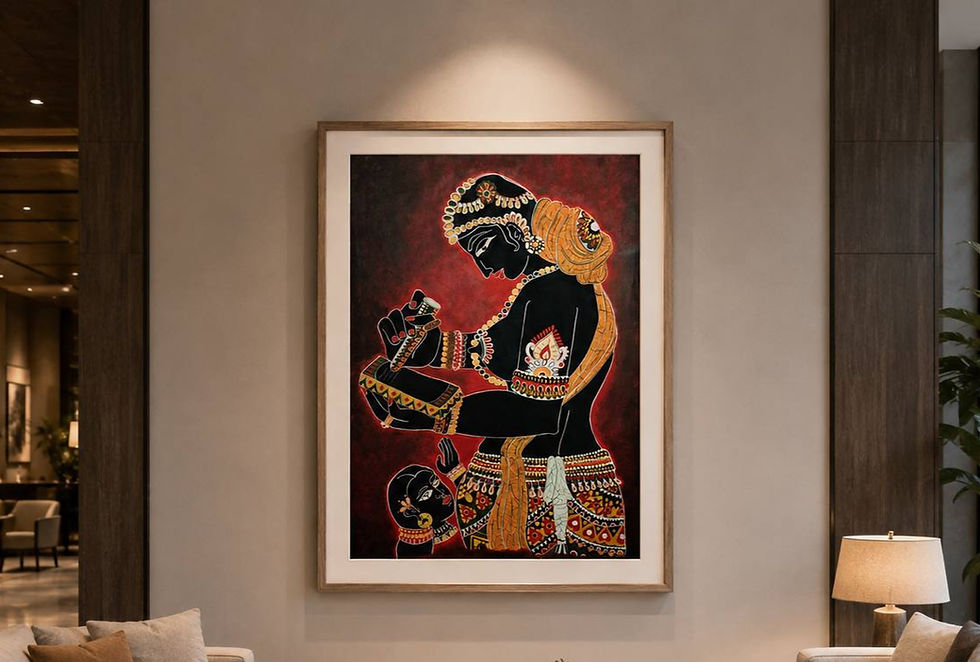
Nzanti's piece Darpan Sundari, part of KSHMEER's collection, takes that gesture and renders it in bold, near-total silhouette: black against a smouldering red, gold line work catching the light, a small figure reaching up from below. Here, a closer look at the painting itself, and the history it quietly carries.
A Brief Note on Her Origins
Darpana Sundari, “the beauty with the mirror,” takes her name from one of the most
celebrated madanikas — carved bracket figures — at the twelfth-century Chennakeshava Temple in Belur, Karnataka, built under the Hoysala king Vishnuvardhana and traditionally associated with his queen, Shantala Devi, a noted dancer of her time. In the original, the figure is caught mid-adornment, gazing into a hand mirror while a small attendant offers up her jewellery below. It's a small piece of history worth knowing — but the real subject of this piece is what Nzanti has done with that inherited gesture on canvas.
The Painting Itself
What makes this artwork unique is the in-depth and sophisticated use of colors. The artist presents a dark outline of the figure that seems to be too simplistic, but once you look closely, it appears that Nzanti used shades of black while making a detailed drawing of the figure. For example, the layering of the crown is presented by dotting with white paint; red and gold bangles can be noticed on the hand; the worn-out white turban can be described as having dark orange colors. All the decorations become visible against the dark red background which seems to be especially providing a magical ambience.
The colour scheme plays a significant role in the emotional impact of the artwork. While the use of a pastel palette might have been more apt for a piece of art that appeals to the visual senses, this piece relies on red and black, which have a strong emotional impact. Its emotion can be equated with that of religious art, and perhaps even the art of shadow puppets. What is more interesting is that the bottom of the artwork contains a figure reaching for the central woman.
Here we see that the lightness of the figure balances the heaviness of the main figure.
In terms of technique, the work is accomplished using acrylic paint on a specially made
hardboard by applying plaster on its surface and then putting the paint on it. As a result, the black surface appears as if it were cut out of stone and not a flat piece of canvas, which makes one remember the original sculptural piece this work was derived from, purposely or accidentally.
The piece is 17 x 12 inches framed, just the right size to fit a wall and at the same time, not to seem too big for the space.
It is the type of work that requires looking at it more than once: first, one will get absorbed by the silhouette and then by the intricate design inside.

Repainting the Gesture
It is really remarkable that the stylization has just this significance in this work. However, by minimizing the body to not more than a black shape with a golden outline, Nzanti brings the idea from the realm of past and well-known tools up to shadow craft and folk silhouette and provides it a kind of impressiveness that the original carving could never have at a distance when being located in a wall of a temple. The medium has changed from chisel and stone to brush and paint but what was done previously has mastered the most complex gestures in the same way.
I find something moving in that shift. This is not a painting that asks to be mistaken for the original carving, nor one that tries to erase where the image came from. It sits comfortably as its own object — a dramatic, contemporary piece built around a pose with real history behind it, made to travel and hang somewhere the original never could.
Why the Piece Works
Part of what makes this painting succeed is how confidently it commits to its own visual
language. There is no attempt to soften the silhouette into something more literal, no
compromise on the intensity of the red. It trusts the viewer to spend time with the black shapes and find the ornamentation inside them, rather than handing over every detail at first glance. That's a harder thing to pull off than it looks, and it's what separates a piece like this from a simple decorative reproduction.
Looking at Nzanti's version, I don't see a history lesson dressed up as art. I see a striking, self-assured painting — one that happens to carry a nine-hundred-year-old gesture inside it, and makes something new out of the carrying.

About the Writer

Zaeem Uddin is a freelance content writer specializing in original, research-driven articles across art, culture, and lifestyle. When he's not writing, he works as a data specialist, turning messy spreadsheets and PDFs into clean, structured Excel sheets, a discipline that carries into his writing as a habit of double-checking every fact before it goes to print.


Incredible