Krishna and Janmashtami: Krishna in Indian Miniature Painting

Krishna has been one of the most enduring subjects of Indian painting. His stories appear repeatedly in the Bhagavata Purana, Ragamala series, devotional literature, and regional painting traditions. The paintings reproduced in these pages show the extraordinary variety with which artists across Rajasthan, Gujarat, Central India, and other regions imagined Krishna—as lover, musician, hero, protector, and divine figure.
As Janmashtami celebrates the birth of Krishna, it is also an opportunity to look at how his stories have been preserved and transformed through painting.
Krishna and the Landscape of Devotion
One of the most distinctive features of Krishna painting is the close relationship between the figure and the landscape.
The painting Krishna and Radha, from Kishangarh and dated approximately 1760–80, presents Krishna, Radha, and one of her companions meeting in a glade. The painting is described as typical of the dreamlike works produced by the Kishangarh school.
Its ethereal atmosphere is enhanced by the glowing yellow-green trees and by the otherworldly faces of the two lovers. Their receding foreheads, long curving eyes, and domed eyebrows are among the most distinctive conventions of the Kishangarh style.
These features developed under the patronage of Maharaja Sawant Singh. The descriptions of Radha in the devotional poetry associated with his court correspond closely to the appearance given to her by the painters.
“Her face is gleaming like the brightness of the sun.”
Her highly arched, finely pencilled eyebrows, long features, curved nose, and graceful lips became part of the visual ideal of Radha.

The painting therefore does more than illustrate Krishna and Radha. It creates an idealized world in which landscape, human beauty, poetry, and devotion become inseparable.
Krishna and Radha

This mixture of characteristics is important because Indian miniature painting cannot always be placed confidently into a single regional category. Many paintings contain elements from several traditions, reflecting the movement of artists, workshops, compositions, and visual ideas.
Krishna as the Destroyer of Demons
Krishna’s artistic identity is not limited to the romantic world of Radha and Vrindavan. He is also represented as the heroic figure who destroys the forces threatening his people.
A Central Indian miniature dated approximately 1680–90 depicts Krishna Slays the Horse Demon Keshi.
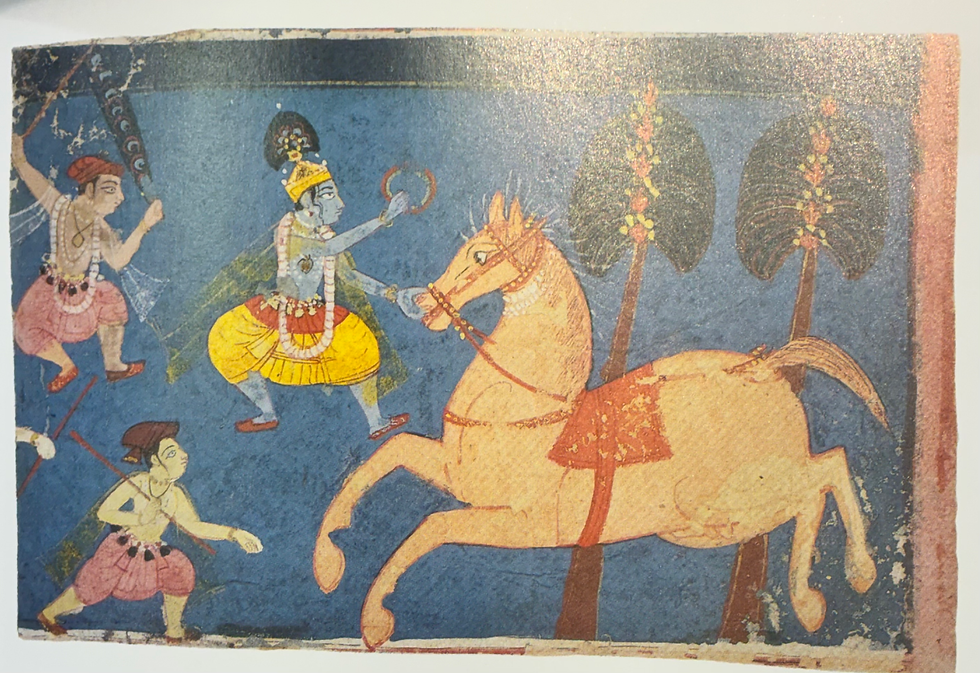
According to the Bhagavata Purana, Krishna was the eighth son of Devaki, and Kamsa, the demon king of Mathura, sought to destroy him. After Krishna’s true identity became known, Kamsa sent the gigantic horse demon Keshi against him.
At Vrindavan, Keshi attacked Krishna. The young god plunged his left arm down the horse’s throat and expanded it to such a size that the beast could no longer breathe. Keshi consequently fell to the ground dead.
The painting captures this moment with considerable animation. Krishna, wearing his peacock-feather crown and holding his flaming discus, grasps the horse’s nose. Two cowherds rush across the intense blue field to aid their friend.
The composition is characteristic of Central Indian painting: strong colours, stylized trees, energetic figures, and a highly organized pictorial structure.
Krishna Slays Bakasura

Another work, a page from a Bhagavata Purana series from Gujarat and dated around 1720, depicts Krishna Slays Bakasura.
The story tells of the demon Bakasura, who appeared in the form of a giant crane near the banks of the Yamuna at Vrindavan. Krishna approached the snowy-white crane and suddenly found himself trapped within its enormous beak.
Heating himself with divine energy, Krishna became so hot that Bakasura had to release him. Krishna then tore the demon’s beak apart, destroying him.
The painting represents the final moment of the myth. Krishna, wearing a gold crown, appears at the centre of the composition while his cowherd companions rush to help.
The scene is surrounded by green, orange, and lavender-blue borders and set against a lemon-yellow ground filled with flowering plants.
The description of the work emphasizes how flat and decorative the composition is, comparing it to the embroidered textiles produced in Gujarat during the same period.
Here, storytelling and ornament become one.
Krishna, Radha and the World of Vrindavan
The world surrounding Krishna is almost as important as Krishna himself.

Trees, flowers, rivers, cows, birds, hills, and gardens repeatedly appear in these paintings. They establish the environment of Vrindavan while also creating an emotional atmosphere.
In the paintings of Krishna and Radha, nature often appears peaceful and abundant. The lovers are surrounded by trees and flowering vegetation, while rivers and lotus-filled waters provide movement through the composition.
The landscape is therefore not simply scenery. It is part of the story.
The natural world becomes a participant in Krishna’s divine play.
The Bhagavata Purana and Painting
Several of the paintings shown in these pages come from Bhagavata Purana series.
The Bhagavata Purana was particularly important to Indian painters because its stories provided an enormous range of dramatic and devotional subjects.
A miniature could represent Krishna’s childhood, his encounters with demons, his life among the cowherds, his relationship with Radha and the gopis, or his later life and adventures.
The paintings demonstrate that artists did not simply reproduce a written narrative. They interpreted it through composition, colour, gesture, architecture, landscape, and decorative pattern.
In some works, several events may even be presented within one composition.
The Story of Shridama

The painting belongs to a large set of seventeenth-century Indian paintings illustrating a Braj translation of the tenth book of the Sanskrit Bhagavata Purana.
The story concerns Shridama, one of Krishna’s childhood friends.
According to the text, Shridama lived an austere life of great purity and meditation. One day his emaciated wife asked him to visit Krishna in Dwarka because Krishna gives riches to the suffering and helps to maintain families.
Reluctantly, Shridama agreed.
He travelled to Dwarka, where Krishna greeted his old friend with great respect and affection. Krishna washed the Brahmin’s feet and performed arati. The two friends spent much of the day speaking about their childhood experiences.
When Shridama eventually returned home, he discovered that his miserable dwelling had been miraculously transformed into a splendid palace with beautiful gardens, groves of trees, and attendants.
The painting attempts to represent several major moments from this changing story.
This is one of the remarkable qualities of Indian miniature painting: a single image can function almost like a visual manuscript, allowing different moments of a narrative to exist within the same pictorial space.
Krishna as a Cultural Memory
The paintings in these pages also demonstrate how varied Indian painting traditions were.
The book points out that many miniatures cannot be assigned confidently to known schools. Some combine elements from different regions, while others reveal the influence of workshops and traditions that are difficult to identify today.
This diversity is particularly visible in paintings of Krishna.
A Krishna painting from Kishangarh may emphasize elongated faces, dreamy landscapes, and romantic devotion.
A Central Indian painting may use energetic figures and strong colour.
A Gujarati work may emphasize flat decorative surfaces and patterns reminiscent of textiles.
A Jaipur painting may incorporate different Rajasthani conventions.
Yet all of them can draw from the same stories.
Krishna therefore becomes a bridge between regional artistic traditions.
Janmashtami and the Continuing Life of Krishna
Janmashtami celebrates Krishna’s birth, but the paintings associated with Krishna remind us that his story does not begin and end with that single event.
His life unfolds through a vast cycle of stories: childhood in Gokul, life in Vrindavan, his relationship with Radha and the gopis, encounters with demons, his friendships with the cowherds, and the events described in the Bhagavata Purana.
Each story gave artists another opportunity to interpret Krishna.
The result is not one fixed image of the god but an enormous visual tradition.
Sometimes Krishna appears as the blue-skinned child. Sometimes he stands beside Radha beneath flowering trees. Sometimes he plays music. Sometimes he confronts a demon. Sometimes he appears within elaborate architectural settings or pastoral landscapes.
The paintings show that Krishna’s presence in Indian art has always been fluid.
Looking at Krishna Through Miniature Painting
Perhaps the most remarkable quality of these works is the way they combine narrative and decoration.
The figures may be small, but their gestures are carefully considered. Landscapes may be stylized, but they establish powerful moods. Trees may be repeated as patterns, yet they create a recognizable world. Colours are often intense and deliberately arranged.
The paintings do not attempt to reproduce the world exactly as the eye sees it.
Instead, they create a visual world appropriate to the story.
This is why the miniature tradition remains so compelling today.
When we look at Krishna and Radha standing beneath trees, Krishna confronting Keshi, or Krishna destroying Bakasura, we are not simply looking at illustrations of ancient stories. We are looking at the interpretations of artists who transformed literature, devotion, regional traditions, poetry, and imagination into visual form.
Krishna, Painting and Janmashtami
Janmashtami is therefore more than a celebration of Krishna’s birth. It is also a celebration of the stories, poetry, music, dance, sculpture, and painting through which Krishna has continued to live within Indian culture.
The miniature paintings reproduced in these pages preserve a particular moment in that long history.
They show Krishna through the eyes of artists from Kishangarh, Jaipur, Central India, Gujarat, and other traditions. They reveal different approaches to colour, landscape, figures, storytelling, and devotion.
Yet beneath these differences is a shared fascination with Krishna.
He remains the child of Gokul, the beloved of Radha, the companion of the cowherds, the destroyer of demons, and the divine centre of the Bhagavata Purana.
Through miniature painting, these stories became images.
And through those images, Krishna continues to be seen, remembered, and reimagined.
This Janmashtami, perhaps one of the most beautiful ways to encounter Krishna is to look closely at these paintings—not merely as illustrations of mythology, but as centuries-old acts of devotion, imagination, and artistic interpretation.


extensive. nice writing. ❤️